Large components up to four metres in height and five metres in length can now be coated fully automatically at Fraunhofer IFAM in Bremen, Germany for current research work. This possibility is offered by a new technical centre, which is to be used in particular for research work on aircraft coatings. This means that large components and curved painted goods, such as those used in aircraft construction, can now also be coated. A painting robot with seven axes is used, which can perform a large number of different painting tasks as an “eierlegende Wollmilchsau”. It is possible to apply both solvent- and water-based paints as well as multi-component systems. The pilot plant is part of the new centre for networked surface and paint technology.
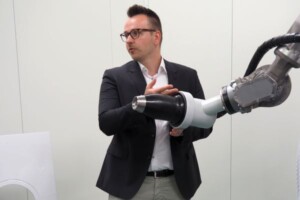
Project leader Björn Speckman explains the features of the new painting robot during the inauguration of the new research centre.
A wide variety of techniques, from pneumatic to airless to electrostatically assisted painting, are available on the market and often lead to different painting results, even when an identical coating material is used. One of the tasks of the centre’s scientists will be to investigate the influence of the application technique on the painting result, in order to then use this knowledge to develop transferable prediction models. For these tasks, the painting robot will be used, which is characterised by a reach of over 2,600 mm and a payload of up to 45 kg, so that it can also be used for paint technology issues from the aerospace industry.
However, the focus will also be on topics such as quality assurance, pre-treatment and, building on this, the use of machine learning systems. For example, it is planned that inline-capable hyperspectral cameras in the near infrared range (900 – 1700 nm) will be able to examine painted goods and provide information about their condition. The cameras are capable of distinguishing between a large number of paint layers and can, for example, provide information on whether the paint layer has been sufficiently cleaned or whether a component has been sufficiently stripped of paint. Even here, modern neural networks are used to process the large amount of information.
With the current set-up, the camera systems can analyse an area the size of DIN A4 in 10 seconds and provide information about the condition. For example, it is possible to determine whether an area has been sufficiently but not too far stripped of paint, e.g. if only the top coat has been removed but the primer should remain. It is also possible to determine whether the surface has been degreased by spraying on water and analysing the water droplets with another camera system working in the visible light spektrum, as this has an influence on the wettability. So far, the IFAM team has mainly collected data with new paint layers, but is also working on analysing old paint layers in order to take ageing processes into account, for example.
This information is then to be coupled with laser decoating or cleaning. This makes it possible, for example, for the laser to specifically treat only those areas that are not yet sufficiently clean.
More information: www.ifam.fraunhofer.de