

Representatives from the companies Safran, the Oerlikon Group, the CNRS and the University of Limoges recently signed a memorandum of understanding announcing the establishment of a joint research laboratory called PROTHEIS in Limoges and a technology platform called SAFIR. The two newly created facilities will specialize in surface treatment for aerospace applications. In the future, lighter and more durable products will be developed, capable of reducing noise and nitrogen emissions in compliance with REACh, meeting the requirements of all types of aerospace applications now and in the future. The lab’s agenda includes the development of digital simulation of processes based on the collection, storage, analysis and use of production data to ensure product quality control. Oerlikon expects the collaboration to intensify its support of the aerospace industry along the entire value chain. The CNRS and the University of Limoges, which operate a joint research facility called IRCER, aim to promote scientific and technical discussions on surface treatment with leading national and international laboratories and to recruit top talent from around the world. The project will strengthen IRCER’s position in the aerospace industry and the training of professionals in conjunction with the ENSIL/ENSCI School of Engineering and the Faculty of Science and Technology at the University of Limoges. It strengthens the ecosystem already in place in Limoges and makes it a unique center of relevant expertise in Europe thanks to the IRCER laboratory, the University of Limoges, the Oerlikon Group and the Center for Development and Surface Treatment CITRA.
Further information: www.oerlikon.com
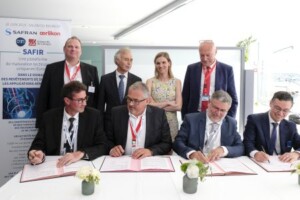
Stéphane Cueille, Senior Executive Vice President R&T and Innovation at Safran, Dr. Roland Fischer, CEO of the Oerlikon Group, Jean-Luc Moullet, Chief Technology Transfer Officer at the French Centre national de la recherche scientifique (CNRS), and Alain Célérier, President of the University of Limoges sign a document to establish a joint research laboratory. Photo: Oerlikon